
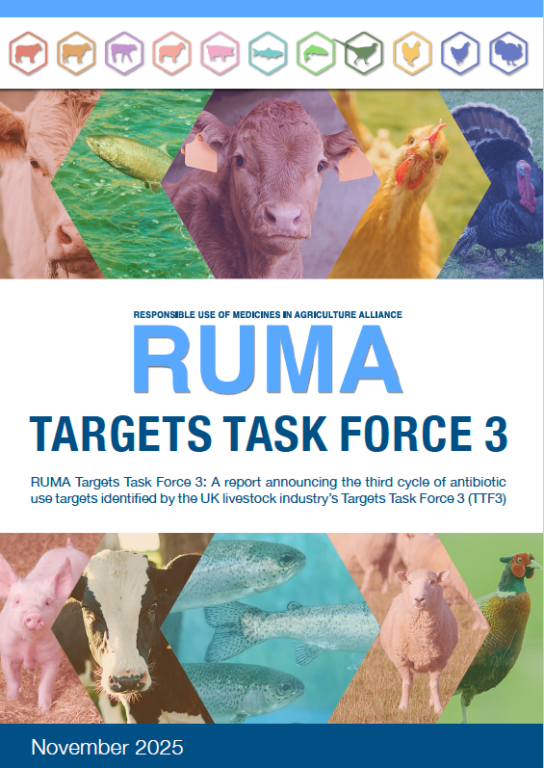
TTF3 banner
RUMA Agriculture Targets Task Force Releases Third Cycle Of AMU Targets For UK Livestock Sectors
 10 months ago
  987 views
The Responsible use of Medicines in Agriculture Alliance (RUMA Agriculture) has today released the third cycle of targets from its Targets Task Force (TTF3) which represents commitments from each livestock sector from 2025 – 2029 in line with the Government’s AMR National Action Plan.
The next cycle of RUMA Targets Task Force targets (TTF3), which have been endorsed by The Animals, Plants, Food and Environment Delivery Board for the UK AMR National Action Plan (NAP), marks another key milestone in the journey of this unique livestock industry initiative; one that has been applauded globally for the reductions in antibiotic use that have been achieved through a movement that has been based completely on voluntary industry collaboration, at all levels, to address AMR.
RUMA Agriculture Chair, Cat McLaughlin, says: “As the TTF group enters its 9th official year in existence, there is much to be praised with what has been achieved to date including a 57% reduction in the use of antibiotics across UK livestock sectors and HP-CIA use is down by 83%. TTF3 continues to grow on these achievements and represents commitments from each livestock sector from 2025 – 2029 in line with the Government’s AMR National Action Plan.”
The newly released report contains a top-level summary of each sector’s TTF3 targets, plus an overview of the wider work underway on AMS activities, projects and campaigns, which will support the delivery of the targets throughout this third cycle of the TTF. The key focus of the TTF group is to demonstrate the UK livestock industry’s commitment to tackling AMR and, where antibiotics are used in farm animals, that they are used responsibly.
Cat continues: “It should be noted that there are several key factors that can affect the journey of the targets. For some sectors, sustainable levels of use may already have been reached and targets are being held from TTF2; this isn’t about being complacent, but there is a need for realism and understanding that in some cases, thejourney ahead will be about maintenance of low use rather than pushing for further reductions which could have a detrimental impact on animal welfare. How the sectors demonstrate their commitment to responsible use varies based on the sector, its size, and their own unique challenges and infrastructures. Some sectors have the benefit of data which helps evidence progress and makes setting targets easier; for others, data is less available but the commitment and focus is still evident in TTF3, just demonstrated differently as can be seen by the work currently underway with the UK Ruminant Antibiotic Stewardship Roadmap. RUMA Agriculture has encouraged sectors to set targets which are relevant and can be properly measured and reported on.
“Vaccine availability has also been and remains a challenge for some sectors and has the potential to affect antibiotic use moving forwards. RUMA Agriculture is pleased to see the recent publication of the Statement of Intent on UK Veterinary Vaccine Availability, by the Veterinary Medicines Directorate (VMD) which has demonstrated a commitment to working alongside the agriculture sector to support farmers having access to the vaccines they need. We are proud to have contributed to this strategic framework & look forward to working with the VMD on a five-year multi-stakeholder UK action plan that will turn these ambitions into reality.
“Other challenges include climate change, the impacts of which creates numerous challenges especially for those farming systems based outdoors. Finally, disease outbreaks such as Avian Flu, Bluetongue, and Schmallenberg, plus, new emerging diseases, all present new challenges to livestock sectors.”
During the next cycle of targets (TTF3), if new reporting metrics become available for the sectors which will help to further demonstrate their responsible use commitments, then these will be introduced if/as appropriate along the way. For example, the ruminant sector is undertaking a key piece of strategic work to shape its future AMU commitments with the launch of the UK Ruminant Antibiotic Stewardship Roadmap; once this roadmap is complete, the targets for the ruminant sector are likely to be evolved and refined.
Abi Seager, CEO at the Veterinary Medicines Directorate, responding to the release of the TTF3 targets said: “VMD welcomes the third set of targets, which reflect the sectors’ long-standing commitment to tackle AMR and continuing their journey of responsible antibiotic stewardship, since the establishment of the RUMA Targets Task Force in 2016. We look forward to the ongoing collaboration between industry and government to improve animal health and antibiotic stewardship.”
The Animals, Plants, Food and Environment Delivery Board for the UK AMR National Action Plan (NAP) said: ‘We welcome and support the RUMA TTF3 Targets as a positive step in progressing the UK’s One Health approach to tackling AMR in food-producing animals. The new national level targets reflect enduring sectoral engagement, continued commitment to responsible antibiotic stewardship, and alignment with the UK AMR NAP, which dates back to the Targets Task Force’s formation in 2016. We commend RUMA and sectors for their leadership in driving continuous improvement in antibiotic use and disease prevention, and tailoring targets to sector-specific challenges. As this work is implemented, we recommend ongoing review and evolution of targets in light of emerging AMU and AMR surveillance data to ensure the hard work of the sectors leads to continued impact in reducing the risk of AMR.’
Baroness Hayman of Ullock, has also supported the work of the RUMA Agriculture TTF and, in a live webinar at the launch of the TTF3 targets on 26 November, she said: “We know that AMR is one of the most pressing health challenges of our time and it’s not just a national issue, it's a global threat that jeopardises human health, animal health, food security, economic stability and our ability to achieve our international sustainable development goals. But tackling AMR requires a one health approach, both domestically and globally, and that means that every sector - that's human, animal and environment, has a role to play. And today's event is a clear demonstration of how the animal health and agricultural sector are facing into that shared responsibility. So, I want to commend the UK livestock sectors for their ongoing commitment to antibiotic stewardship. The new national level targets reflect enduring sectoral engagement, continued commitment to responsible antibiotic stewardship and alignment with the UK AMR NAP, which dates back to the Targets Task Force's formation back in 2016.”
Making reference to the reductions in use achieved to date and the declining resistance trends, Baroness Hayman of Ullock noted that, ‘these achievements place the UK amongst the most progressive nations in tackling AMR in agriculture’, and that they ‘are a testament to the dedication and collaboration across the UK's farming industry and veterinary sector.’
Baroness Hayman of Ullock, added: “I want to congratulate RUMA for its leadership and the Targets Task Force representatives for your tireless efforts. Your work has set a global benchmark for responsible antibiotic use in agriculture and, as we enter this next phase, I encourage everyone - farmers, vets, industry leaders, to back these targets wholeheartedly. Every contribution matters and together, we can ensure that antibiotics remain effective, safeguarding both animal health and welfare, and public health.” Finally, Baroness Hayman of Ullock went on to deliver the following rallying call: “AMR is a shared challenge and it demands a shared response. So, I urge the entire livestock industry to support the RUMA targets and to continue to drive progress in preventing infections, ensuring responsible antibiotic use, and improving the collection of actionable data because by doing so, we protect not only the health of our animals, but the health of our communities and future generations.”
Cat Mclaughlin concluded today’s launch webinar by saying: “I have been involved with the TTF since it started back in 2014, and I know the effort and commitment that the sectors have all made to this industry success story. I step down as RUMA Agriculture Chair next year, and I can honestly say that working with the sectors has been a career highlight. But, I think we also have to recognise that the combined success has now built an expectation that every year will see further reductions. This is not realistic, nor would it be fair to let that expectation go unchallenged.
“RUMA Agriculture has always held true to its mantra of ‘as little as possible, as much as necessary’, and I think we should stress that over the next TTF period, this remains a relevant principle. Reductions in antibiotic use can only be made by balancing the health needs of animals under our care with a functioning and sustainable agricultural sector. We will continue to need antibiotics in our health toolbox, but we also need vaccines, skilled and dedicated stock people and vets, and a supportive farming infrastructure around us.”
The new targets (TTF3) are released a week after the launch of the final report in the TTF2 cycle of targets (2020-2024) which was launched alongside the Veterinary Medicines Directorate’s Veterinary Antimicrobial Resistance and Sales Surveillance (VARSS) Report. These reports both show that the UK maintains its position as one of the lowest users of antibiotics across Europe, according to the most publicly available data and it has also succeeded in achieving some of the biggest reductions in AMR across Europe in the last decade. RUMA Agriculture is also pleased to see that data published earlier this year from the Animal Plant and Health Agency (APHA) and VMD reveals a strong link between reduced antibiotic use and reduced antimicrobial resistance in UK animals.
Click here to read the TTF3 targets report and all previous TTF reports. Today’s TTF3 launch webinar can be watched here.
More from RUMA
- RUMA Agriculture announces new Chair and pays tribute to outgoing leader’s exceptional legacy
- Latest RUMA Agriculture Targets Task Force report released - the last of the TTF2 cycle marking another important and valuable phase in the livestock industry’s antibiotic stewardship journey ahead of TTF3 launch
- RUMA CA&E announces National AMU Reduction Targets for companion animals
- Latest RUMA Targets Task Force report reveals UK livestock sectors continue to make positive progress on antibiotic use targets
- RUMA 2023 conference - a one health view on the responsible use of medicines

 2 weeks ago