
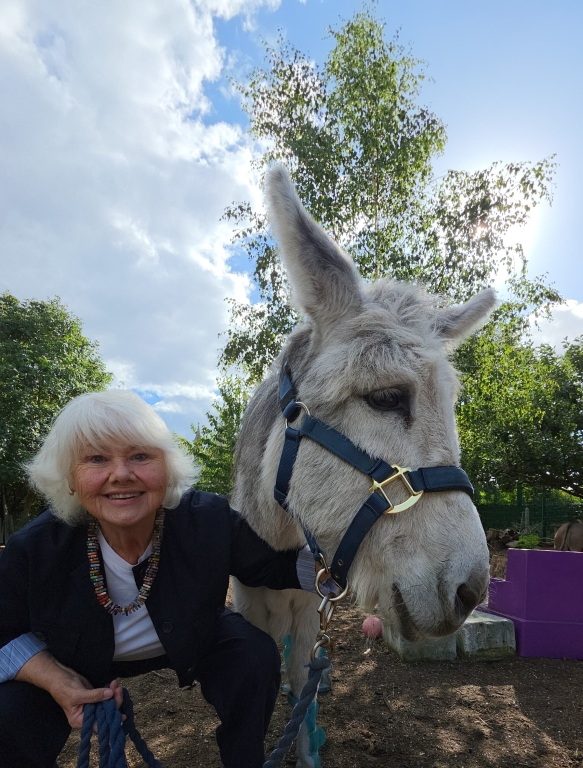
Annette Badland has been appointed to a critical Women's Ambassador role at Brooke.
Actress Annette Badland Appointed Women's Ambassador To Raise Awareness On Gender Equality Issues In Working Animal Communities
 10 months ago
  1038 views
The new Ambassador role will support global working animal charity, Brooke
The role is calling for recognition and investment for women in the livestock sector through the UN’s International Year of the Woman Farmer in 2026
Beloved actress Annette Badland (Midsomer Murders, Ted Lasso) has been newly appointed to a critical ambassador role at working animal charity Brooke, to elevate its work globally and contribute to highlighting gender equity issues in communities where women are the leaders and carers for working equines.
As a passionate advocate for women’s rights and for the protection of working horses and donkeys, Annette is highlighting how the two are crucially intertwined and how, when communities locally lose their animals – be that through the harrowing donkey skin trade, climate disasters or conflicts - it can often be women who are hit the hardest.
An estimated two-thirds of livestock keepers in developing countries – approximately 400 million – are women. There can often be a significant gender disparity as women are responsible for caring for the animals, rely on them for their family’s livelihood while not having the decision-making power or face barriers to access animal health systems and services.
Women who live in communities living in poverty depend on working horses and donkeys to support them with physically demanding and time-consuming tasks such as fetching water and food, or agricultural work like ploughing and harvesting. Without their animals, this strenuous work would need to be done manually, predominantly by women and young girls.
Equines also make a vital contribution to family livelihoods, transporting produce to market, carrying building material or carrying tourists to support families to earn income. Income from these working animals helps women pay for household essentials such as healthcare, food and their children’s education.
Brooke is calling on policymakers to:
Recognise and value unpaid care and domestic work of women in the livestock sector.
Improve women’s access to services such as veterinary care for their animals, economic opportunities such as loans, and training in animal husbandry.
Promote and support women’s access to livestock-related professions, including veterinary medicine and farriery.
Promote shared decision-making responsibility over livestock management and care within the household and the family.
Ban the slaughter of donkeys for their skins that disproportionately affects women and girls.
Annette said:
"Becoming Brooke’s new women’s ambassador means a great deal to me. I’ve always admired the charity’s work with working equines and the women who care for them every day.
“These animals are the backbone of so many communities and the women who look after them deserve real support and recognition.
"I hope being involved in such a vital cause and shining light on these stories will help others to support women-led initiatives and policy around the world.”
Brooke’s Global Head of Policy and Advocacy, Anna Marry, said:
“The UN has declared 2026 the International Year of the Woman Farmer, which is a crucial opportunity to fight for true gender equality within farming communities.
“Women carry the bulk of the burden of heavy agricultural work and livestock care, yet this unpaid labour isn't fully recognised in the household or at the policy level. Women farmers do not have equal access to training, credit and gender responsive veterinary services.
“But when they do, they can transform the welfare of their animals and benefit the whole community.
“Women are at the heart of change - fostering resilience and leadership in communities, caring for working animals and gender equality is essential for thriving communities and animal welfare.”
Voices of women:
India:
Brooke India trained Safura to be an Ashwasakhi, meaning ‘horse friend’. The training included horse care, administering medication and dietary needs. She became an Ashwasakhi because there wasn’t much help available for animals when they needed it, so she wanted to learn how to care for them. She is the only Ashwasakhi in her village by the sea.
Before the training, Safura and others in the village lacked knowledge and were worried when their horse fell ill, as they didn't know how to help. “I felt very bad. We had no knowledge on why he falls sick. We used to get worried just like a member of the family. Everyone was worried that he was suffering. When the horse fell sick, everyone fell sick.”
However, after learning from Brooke India, Safura gained confidence in treating horses, and their health has improved, meaning she is a leading member of her community.
Senegal:
Since her father died, Dieyanba in Senegal has been relying on her donkey, Laura, to support her family with errands and harvesting crops so they can survive. They work together when there is something to be done. Thanks to Laura, Dieyanba can go to the market to buy clothes, food to cook, stationary and pay school fees for her children.
"I would find it very hard to work if I didn't have her, because she helps me”, Dieyanba said.
"Laura is part of our family."
Kenya:
Josephine, a 58-year-old widow and mother of nine from Kakulolo village, Kenya, has faced years of hardship since losing her husband. Caring for four school-going children, she relied on her donkey to fetch water, transport goods, and earn a small income. In May 2024, her donkey was stolen and slaughtered for the donkey skin trade, leaving her struggling with poverty and despair.
In July 2025, hope returned when Brooke East Africa found her a rehomed donkey named Kamwana. The donkey was delivered with the support of her women’s group, who contributed to building a secure shelter to prevent future theft. Laughter, songs, and ululations celebrated this life-changing moment.
More from Brooke
- Unseen experts: Women remain sidelined despite being leaders on pandemic prevention
- Brooke and the Worshipful Company of Farriers launch farriery award
- Learning in the digital era: Empowering vets in developing countries
- Charity urges compassionate treatment of donkeys after Santorini reality TV scenes
- Horses bring Brits’ Christmas coffee and chocolate – but what about their welfare?

 2 weeks ago