
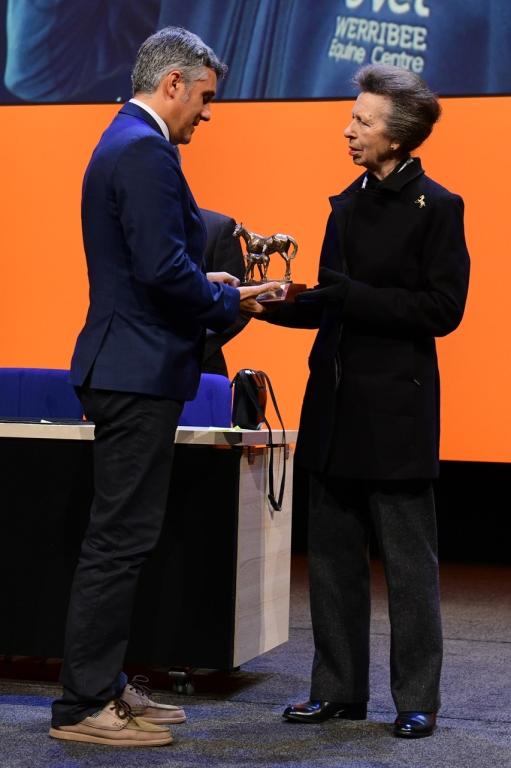
Credit @JasSansi and BEVA Congress 2025
PPID Research Conducted By Feed Brand Collaborators Wins Respected Veterinary Award
 11 months ago
  740 views
New veterinary research on pituitary pars intermedia dysfunction (PPID) – also known as Equine Cushings disease/syndrome, conducted by international veterinary research collaborators, in conjunction with the SPILLERSTM brand, has won a prestigious veterinary award.
Nicolas Galinelli the leading author of the paper was presented with The Peter Rossdale Equine Veterinary Journal (EVJ) Open Award by Her Royal Highness The Princess Royal as part of the formal awards ceremony at BEVA Congress last month.
The study, entitled Effect of pergolide treatment on insulin dysregulation in horses and ponies with pituitary pars intermedia dysfunction was undertaken at the University of Melbourne in partnership with the SPILLERS brand, Boehringer Ingelheim Vetmedica, Queensland University of Technology and the Australian Research Council. The award is given for the paper that best achieves EVJ’s mission to publish articles which influence and improve clinical practice and/or add significantly to the scientific knowledge that underpins and supports veterinary medicine in relation to the horse.
The work enhances practical veterinary knowledge on how to manage and reduce the risks of laminitis. The results showed that pergolide mesylate, the most common drug used to treat PPID, may reduce the amount of insulin produced in response to eating, in horses and ponies that have PPID together with Insulin Dysregulation. However, pergolide treatment alone was not sufficient to bring high insulin levels back to normal. Therefore, an appropriate low sugar and starch diet remains important, to help keep insulin levels as low as possible.
The research forms part of ongoing work by the SPILLERS brand and collaborators to help senior horses live happier, healthier lives for longer. It is the second time that a SPILLERS brand-associated study has won The Peter Rossdale Equine Veterinary Journal (EVJ) Open Award. In 2023 the award was presented to Edward Knowles for the paper Predictors of laminitis development in a cohort of non-laminitic ponies**. This study showed the importance of high insulin levels for predicting laminitis development. Subsequent work has shown that insulin levels can be high in both fat and lean ponies. The results of these studies highlight the need to identify those horses at highest risk of laminitis and to control insulin levels in horses by appropriate feeding.
“Many congratulations to Nicolas Galinelli on winning this highly regarded award,” said Sarah Nelson Product Manager at Mars Horsecare, home of the SPILLERS brand. “We are very proud to be involved with these important studies. They continue to provide crucial practical knowledge about the diagnosis and management of PPID and other risk factors, to help reduce the risk of laminitis.”
For further information check out the SPILLERS science blog here.
The full research paper is published in the Equine Veterinary Journal and is available to view on online for free here.
If you’re concerned about the possibility of PPID and/ or ID, speak to your vet for advice so that suitable management and/ or treatment can be started as soon as possible.
For specific feed and management advice contact the SPILLERS brand’s team of friendly nutrition specialists on 01908 226626
*Reference
Galinelli NC, Bamford NJ, Erdody ML, Mackenzie SA, Warnken T, Harris PA, et al. Effect of pergolide treatment on insulin dysregulation in horses and ponies with pituitary pars intermedia dysfunction. Equine Vet J. 2025. https://doi.org/10.1111/evj.14468
**Reference
Knowles, E.J., Elliott, J., Harris, P.A. Chang, Y.M. and Menzies-Gow, N.J. (2023) Predictors of laminitis development in a cohort of non-laminitic ponies. Equine Veterinary Journal 55 (1) 12-23
Further information from: Bright Bay, 07768 958911, [email protected]
More from BEVA

 24 hours ago