
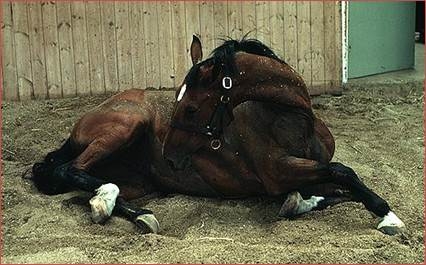
Horse with signs of colic
Keeping Up With The Strongyles
 11 years ago
  1641 views
The most effective methods for controlling worms in horses continue to evolve as science brings us new research. The worming experts at Zoetis are keen to keep horse owners as up-to-date as possible. While faecal worm egg counts and selected treatment continue to be best practice during the summer, new information about large strongyles (also known as large redworms) is emerging.
Large strongyles are found in the large intestine, are dark red in colour and can grow up to 5cm long. The developing larval stages can block blood vessels to the gut and cause colic, which can be fatal. It has been widely accepted that the use of modern wormers has reduced the large strongyle population so that they are no longer as prevalent.1 However, recent data from Denmark now suggests that burdens of large strongyles may re-appear in horses that have not received any wormer for a number of years.2
Danish prescription laws only allow administration of a wormer based on a proven diagnosis of a significant burden. They do not allow routine or preventative treatment of worms, thus in extreme cases some horses have not received a wormer for many years. Whilst it is important not to overuse wormers to prevent resistance, complete lack of any administration may allow large strongyles to gain a footing once more – a fine balance needs to be maintained.
In the UK, current general guidelines for worm control in adult horses involve treating strategically for encysted small redworm in late autumn/early winter, and treating or testing for tapeworm in autumn and spring. Then when the weather warms up, and worms become more active, owners should conduct FWECs every six to eight weeks until October to identify any horse requiring additional treatments for small redworm. In view of the new information if there is any history of a large strongyle burden or a record of associated colic, your vet may advise a specific, once or twice-yearly treatment for these parasites.
Wendy Talbot, Zoetis vet said: “Selected worming, based on faecal worm egg counts, remains key during the summer. Control of large redworm should be achieved with one or two treatments each year, effective against the dangerous migrating stages of this parasite. For many horses their current worming plan will already incidentally have provided these treatments during control of the more common small redworm, However, for some an additional treatment may be required. As always the best approach is to speak to your prescriber to assess the risk to your individual horse and the suitability of your worming plan.”
For further information, visit www.wormingyourhorse.info. You can also download Stable Mate, the horse health management app from Zoetis. It is available from the iPhone app store and Google Play Store: text Stable Mate to 80800 to download. (Standard network charges apply. By responding to this text you are consenting to your data being held either within or outside the EEA and processed by or on behalf of Zoetis to administer and manage any matters relating to Zoetis’s future activities or initiatives. For our full privacy policy visit www.zoetis.co.uk).
Further information is available from: Zoetis UK Ltd.,?Walton Oaks, Dorking Road, Walton-on- the-Hill, Tadworth, Surrey KT20 7NS Customer Support: 0845 3008034, www.zoetis.co.uk.
Use medicines responsibly: www.noah.co.uk/ responsible/
References
1 Love et al (1999) Veterinary Parasitology 85, 113-122
2 Reinmeyer CR & Nielsen MK. (2013) Handbook of equine parasite control, Wiley-Blackwell. pp. 146-147
More from Zoetis
- Zoetis Adds Equine Hematology Capabilities to Vetscan OptiCell™ and Vetscan Imagyst®
- Vets encouraged to talk to their farming clients about clostridial diseases in beef cattle
- Zoetis Receives Approval for Portela® (relfovetmab injection) in Great Britain
- Zoetis Receives Approval for Lenivia® (izenivetmab) in Great Britain
- Equine Vets Invited to Build Communication Confidence and Clinical Influence
