
Credit: Brooke
Protection For Working Animals Must Be Urgently Secured As Water Crisis Ravages Communities Around The World
 1 year ago
  4887 views
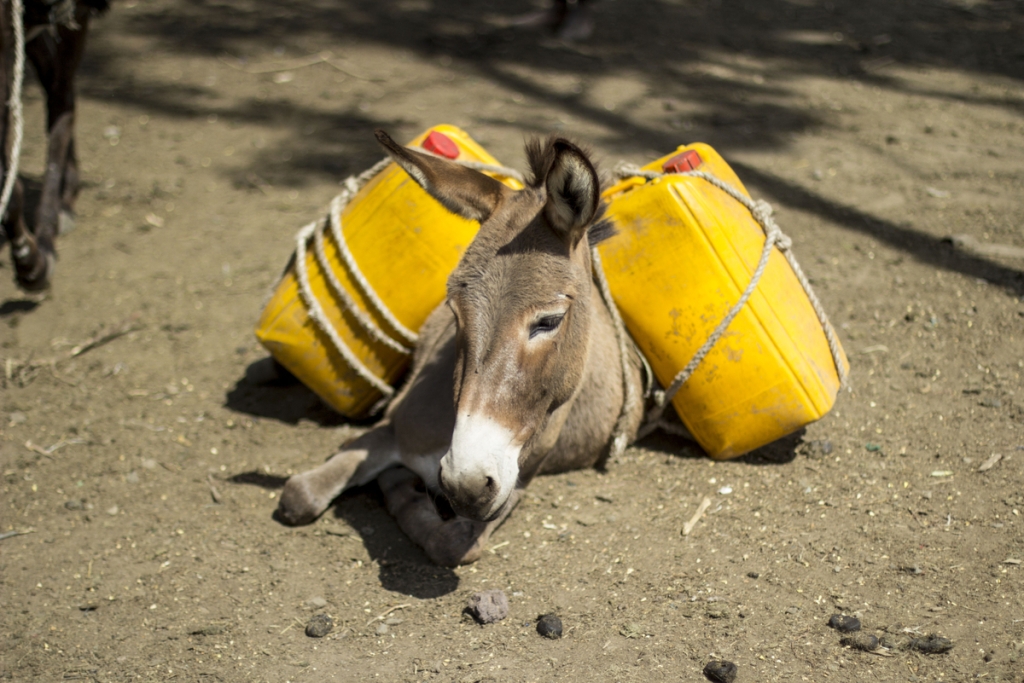
Donkeys and horses are the only way to access water for many communities.
Thousands of working donkeys, horses and mules are suffering as water is increasingly hard to find.
The illegal donkey skin trade is fuelling a crisis for women and girls as they take on the role of water-gatherer.
Global governments must urgently recognise working livestock in the UN's Sustainable Development Goal-6 on clean water and sanitation.
This World Water Week (24-28 August 2025), working animal charity Brooke is calling on global governments and international organisations to urgently recognise the role of working animals in meeting the Sustainable Development Goals (SDGs) by 2030 - including SDG 6, which stipulates access to clean water and sanitation.
Communities living in rural areas of developing countries often travel vast distances to obtain fresh water and for many, this journey is made possible by owning a horse or donkey. The water is used by families for drinking, to cook, maintaining basic hygiene standards, watering crops and providing drinking water for other farm animals.
The water transported by working equines is used to irrigate crops. It is also given to other species of livestock. This helps the owners increase crop yield and livestock production, leading to improved livelihoods and health.
Working animals may also be the only source for bringing life-saving water to people and livestock. In the groundnut basin and the sylvo-pastoral zone in Senegal, donkeys supply water to 400,000 small ruminants every day.
Animals are often simply forgotten in these metrics. But, if the contribution of working animals isn’t recognised in policy and planning, then millions of rural communities risk losing access to vital water resources, with devastating impacts on human and animal health, food security, and livelihoods.
Donkey skin trade trade devastating communities and fueling gender disparity
The global donkey skin trade is also having a devastating knock-on effect on communities in West and East Africa and Pakistan, as working animals are stolen to meet the horrific trade – often leaving women and children responsible for collecting water.
In many communities across Africa, Asia and Latin America, women and girls must walk long distances to fetch water from a water hole or a pump. This means they have less time for other tasks, and many girls are pulled out of school to help with water provision and other household chores.
Equines can transport more water across large distances, freeing women’s and girls’ time for other activities, from community meetings to education, thus leading to greater gender empowerment.
In Pakistan, women who own a donkey cart can bring water, wood and fodder home in an hour and a half, as opposed to four hours for women who do not have a donkey.
The rising number of donkeys stolen to fuel the illegal trade in skins to obtain ‘ejiao’ – a gelatine used in traditional Chinese medicine that is made by boiling down donkey skin.
With many countries banning the practice and trade, working animals are being stolen to fuel the illegal trade, leaving communities at risk and, in many cases, women and girls then taking on the role of water gatherer.
Brooke’s Global Head of Policy and Advocacy, Anna Marry, said: “As climate change and the global water crisis deepen, the poorest and most vulnerable communities are worst affected.
“For many of them their working donkey or horse is the only lifeline they have to help them fetch water, put food on the table and be more resilient in the face of climate disasters.
“Thanks to Brooke's advocacy, the UN now recognises the role working animals play in agriculture and in disaster resilience.
“This is great, but not enough. There is no food without water, there is no life without it.
“In light of the UN’s 2025 World Water Development Report spotlighting how climate stress is shrinking water sources, we urge immediate recognition of working animals’ role in water resilience and a commitment to their welfare.”
Even in the UK, the impacts of water scarcity are increasingly visible. For many of us, these restrictions might mean a watered-down garden or a temporarily brown lawn - but for millions of people in developing countries, the stakes are far higher.
Protecting working animals abroad and learning from their critical role in water transport can help communities worldwide adapt to climate pressures and secure a future where water is both available and sustainably managed.
Equines as a vital connection to a water source
In Ethiopia, water pumps and cattle troughs built by Brooke are benefitting nearly 250,000 people in the Oromia region and 71,500 people in the SNNP region. This new infrastructure is managed by water committees made up of local people, with the support of local authorities.
In La Esperanza community in Guatemala’s ‘Dry Corridor’ (a region suffering from severe water shortages), Brooke and its partner ESAP have constructed a water spring that has benefitted 150 animals and more than 200 families. This spring is the only source of safe water for the families in La Esperanza and neighbouring villages of El Cujito, El Morrito and La Candelaria.
In Burkina Faso, Brooke and its partner Inades-Formation have built a new borehole that includes a solar pump for people and a water trough for cattle in the village of Silmiougou. The new infrastructure provides clean drinking water to an estimated 5,000 people in Silmiougou and neighbouring villages of Tangasgo, Tansega and Tansablougou.
ENDS
Notes to Editor:
For spokesperson, interview or case study enquiries, please contact India Hurford-Jones (Media and Mobilisation Officer at Brooke) - [email protected] or 020 7653 5885.
- On average, a donkey needs to drink between 18-35 litres of water a day, more if they are working in hot conditions.
- A horse needs to drink slightly more – between 25-35 litres of water a day. This increases if they are in hot conditions.
- Fatalities are a very high risk, while the short-term effects of not drinking enough water include lethargy, weight loss and poor health.
- Learn more about how Brooke is bringing water to communities and animals here.
About Brooke:
Brooke Action for Working Horses and Donkeys is a UK-based, global animal health and welfare charity that gives working horses, donkeys and mules a life worth living.
Over 100 million of these animals pull carts, carry goods and work the land, earning an income that around 600 million people rely on to put food on their tables, earn a living and send their children to school. Sadly, many of them are suffering, so Brooke works with owners, communities, service providers, governments and international organisations to make long-lasting welfare improvements.
Brooke was founded in 1934 when Dorothy Brooke, a British woman, sought out war horses that had been left in Cairo after the First World War. With support from an appeal letter in the Morning Post newspaper, she set up the Old War Horse Memorial, which became Brooke, and expanded across Africa, Asia, and Latin America.
Website: www.thebrooke.org
Facebook: thebrookecharity
Twitter: @thebrooke
Instagram @thebrookecharity
More from Brooke
- Unseen experts: Women remain sidelined despite being leaders on pandemic prevention
- Brooke and the Worshipful Company of Farriers launch farriery award
- Learning in the digital era: Empowering vets in developing countries
- Charity urges compassionate treatment of donkeys after Santorini reality TV scenes
- Horses bring Brits’ Christmas coffee and chocolate – but what about their welfare?

 23 hours ago