
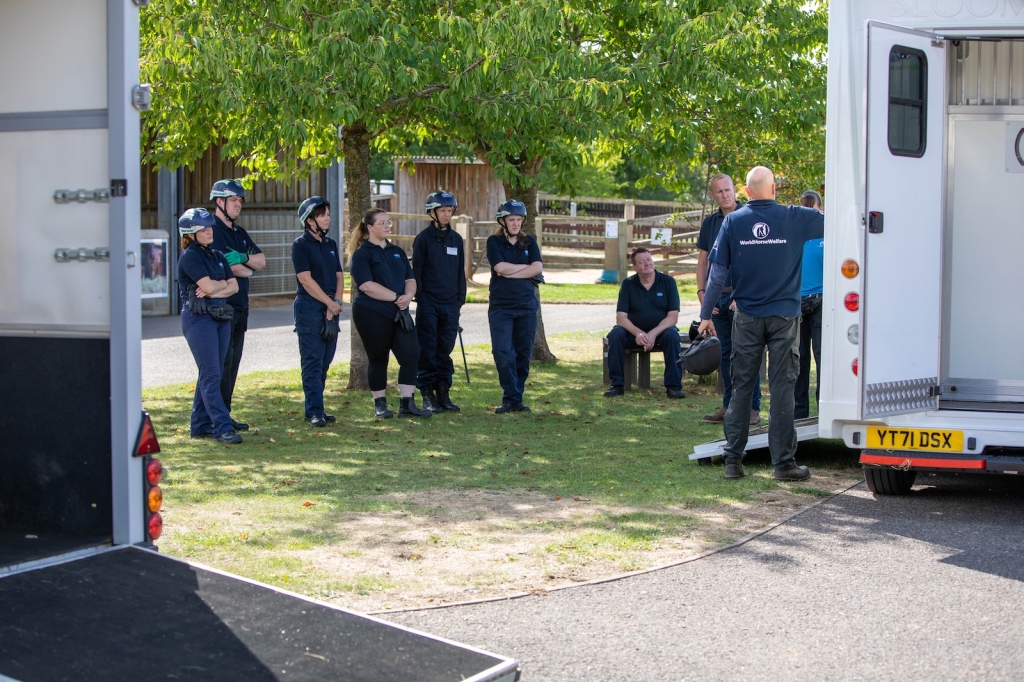
Learning about loading horses
Charities Combine Strength For The Benefit Of Horse Welfare
 4 years ago
  1031 views
Staff at two World Horse Welfare Rescue and Rehoming Centres welcomed groups of new RSPCA Inspectorate recruits for training to prepare them for assessing and handling any horses they may come across when attending welfare concerns around the country.
Both animal welfare charities have pooled their expertise for the first time to train the latest intake of Animal Rescue Officers with both theory learning and practical hands-on experience. Twelve recruits got to grips with horses at World Horse Welfare’s Hall Farm Rescue and Rehoming Centre in Norfolk and another group of eleven were hosted by Penny Farm, the charity’s centre near Blackpool. Each group of Animal Rescue Officer recruits spent two days at one of the farms. The RSPCA deals with many different types of animals and whilst a number of officers are already experienced horsewomen and men, some of the new recruits may have had little or no experience of horses.
Melanie Fisher, RSPCA Inspector - Learning & Development, said: “Dealing with any animal involves risk and horses are large animals with high risk, so learning how to handle them safely and effectively is essential. Learning how to approach horses in the stable and in the field, and to assess their body condition is so useful. To be able to come to a World Horse Welfare farm and gain knowledge and expertise from them in an area they excel in has been invaluable. World Horse Welfare is a great partnership for us, we value their expertise in the equine field.”
Jon Phipps, World Horse Welfare Deputy Chief Field Officer and course leader said: “Collaborative working between the equine charities is now the norm, particularly on large cases. We can meet each other and see how each other works and how the teams operate, because these are the guys we will be calling out if we need them, and vice versa.”
On the first day of each course the groups learned how to approach horses in the field and in stables, how to hold and examine them safely and how to lead them. Dealing with difficult horses was covered as well as finding out what to look for when assessing the horse’s condition. These practicals were interspersed with classroom sessions on such diverse topics as euthanasia and trespass laws.
On the second day the rounding up and loading of horses onto horse transport was practiced and a final practical mock case brought everything the group had learned into action.
Considering the future of this collaborative course Jon Phipps said: “We all bring different specialities to the table and we need that breadth of knowledge and experience. We aim to repeat this course and to continue for each new intake, to develop this partnership for the benefit of horse welfare”
The group of students that spent two days at Hall Farm was filmed and a short video of the benefits of the collaboration alongside their training experiences produced, which can be watched HERE
More from World Horse Welfare
- World Horse Welfare unveils fresh new look ahead of our centenary at Defender Burghley Horse Trials where we're Charity of the Year
- Popular video series Horses Explained returns with expert line up
- Orphan foal saved by Norfolk rescue centre is ready for a forever home
- Leading charity launches free tool to help assess horses’ welfare on yards
- World Horse Welfare statement in response to the UK Government's new Animal Welfare Strategy
