
Sussex Vet Treats Rare Sloth Bears In Shadow Of Taj Mahal
 13 years ago
  2267 views
Posted
10th June, 2013 20h57
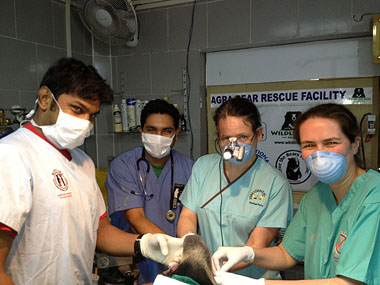 Grove Lodge Vet Rachel Perry helps out poorly Indian bears
What did you do at work today? For vet Rachel Perry, who has a special interest in dentistry at Grove Lodge Vets, has just returned from treating Sloth bear teeth in India!
Rachel was invited out to the Agra Bear Rescue Facility in India by International Animal Rescue and veterinary colleague Lisa Milella to help inspect and treat the bears’ teeth within the sanctuary, and provide veterinary dental education for local vets.
Originally classified as sloths due to their long claws, Sloth bears’ diet consists mainly of fruits, honey, and insects - especially termites and ants. Stocky, with a long shaggy black mane and white ‘V’ shaped marking on their chest Sloth bears can weigh anything from 60-150kg, and live for 20-25 years. Classified as ‘vulnerable’ and protected under CITES (Convention on International Trade in Endangered Species) regulations, Sloth bears are threatened by habitat loss, and hunted due to destruction of crops or aggressive behaviour.
Sadly Sloth bears have also traditionally been used as dancing bears, with cubs bought or poached then trained to ‘dance’ to entertain people and earn their keepers money. To make bears ‘safer’ to handle, young cubs would have their teeth broken with a hammer, and rope or ring placed through their nose and muzzle with a hot poker leading to numerous painful problems within their mouth and teeth.
Amongst a host of life-threatening injuries, these excruciatingly painful broken teeth quickly become severely infected with root abscesses. Although ‘dancing bears’ were outlawed in 1972 there were still around 800 bears wandering the roads between Delhi, Agra and Jaipur by the late 20th Century; about 300 of whom are now safely housed and receiving the veterinary care they need at the Agra rescue sanctuary, which also supports the locals by providing education and employment.
Rachel says “Of course I jumped at the chance to be involved in such an exciting project! Anaesthetic gases, tubes, and XRays we used are very similar to the ones used for dogs and cats at Grove Lodge Vets - but we don’t normally have to blow-dart them first!”
But these bears suffer from different types of painful dental problems to our domestic pets. Rachel continues “Some of the bears’ teeth had been damaged by their original owners for the purposes of dancing; the canines would be broken off with hammers.
“Not only is this painful, but also allows infection to enter the root and cause an abscess. Sometimes the teeth were pushed further into the jaw, creating deformed teeth trapped within the bone. Teeth would also wear down naturally due to the ‘sand-blasting’ effect of sucking up termites.”
Dental vet Rachel was able to save some larger teeth by performing root canal procedures similar to humans. Other teeth that could not be saved were extracted - not an easy procedure due to their size so surgical extractions were performed instead.
The bears all made very smooth recoveries, and are now able to live peaceful, safe lives in comfort and enjoying huge amounts of space to perform their natural behaviours; as well as climbing frames to exercise, ponds to cool off in, and tree trunks hiding delicious honey!
For more info about the sanctuary, International Animal Rescue, or to donate visit www.iar.org.uk.
Grove Lodge Vet Rachel Perry helps out poorly Indian bears
What did you do at work today? For vet Rachel Perry, who has a special interest in dentistry at Grove Lodge Vets, has just returned from treating Sloth bear teeth in India!
Rachel was invited out to the Agra Bear Rescue Facility in India by International Animal Rescue and veterinary colleague Lisa Milella to help inspect and treat the bears’ teeth within the sanctuary, and provide veterinary dental education for local vets.
Originally classified as sloths due to their long claws, Sloth bears’ diet consists mainly of fruits, honey, and insects - especially termites and ants. Stocky, with a long shaggy black mane and white ‘V’ shaped marking on their chest Sloth bears can weigh anything from 60-150kg, and live for 20-25 years. Classified as ‘vulnerable’ and protected under CITES (Convention on International Trade in Endangered Species) regulations, Sloth bears are threatened by habitat loss, and hunted due to destruction of crops or aggressive behaviour.
Sadly Sloth bears have also traditionally been used as dancing bears, with cubs bought or poached then trained to ‘dance’ to entertain people and earn their keepers money. To make bears ‘safer’ to handle, young cubs would have their teeth broken with a hammer, and rope or ring placed through their nose and muzzle with a hot poker leading to numerous painful problems within their mouth and teeth.
Amongst a host of life-threatening injuries, these excruciatingly painful broken teeth quickly become severely infected with root abscesses. Although ‘dancing bears’ were outlawed in 1972 there were still around 800 bears wandering the roads between Delhi, Agra and Jaipur by the late 20th Century; about 300 of whom are now safely housed and receiving the veterinary care they need at the Agra rescue sanctuary, which also supports the locals by providing education and employment.
Rachel says “Of course I jumped at the chance to be involved in such an exciting project! Anaesthetic gases, tubes, and XRays we used are very similar to the ones used for dogs and cats at Grove Lodge Vets - but we don’t normally have to blow-dart them first!”
But these bears suffer from different types of painful dental problems to our domestic pets. Rachel continues “Some of the bears’ teeth had been damaged by their original owners for the purposes of dancing; the canines would be broken off with hammers.
“Not only is this painful, but also allows infection to enter the root and cause an abscess. Sometimes the teeth were pushed further into the jaw, creating deformed teeth trapped within the bone. Teeth would also wear down naturally due to the ‘sand-blasting’ effect of sucking up termites.”
Dental vet Rachel was able to save some larger teeth by performing root canal procedures similar to humans. Other teeth that could not be saved were extracted - not an easy procedure due to their size so surgical extractions were performed instead.
The bears all made very smooth recoveries, and are now able to live peaceful, safe lives in comfort and enjoying huge amounts of space to perform their natural behaviours; as well as climbing frames to exercise, ponds to cool off in, and tree trunks hiding delicious honey!
For more info about the sanctuary, International Animal Rescue, or to donate visit www.iar.org.uk.More from
- Dignipets expands mobile end-of-life veterinary care into Plymouth and Exeter
- Vets Now marks 25 years with Pet Emergency Week campaign
- VDS launches VetResolve to help practices meet new complaints handling requirements
- Ronda.vet links locum shifts to CPD rewards in UK veterinary first
- Cancellations have been damaging locum work for years but no-one was keeping count - now Ronda is
