
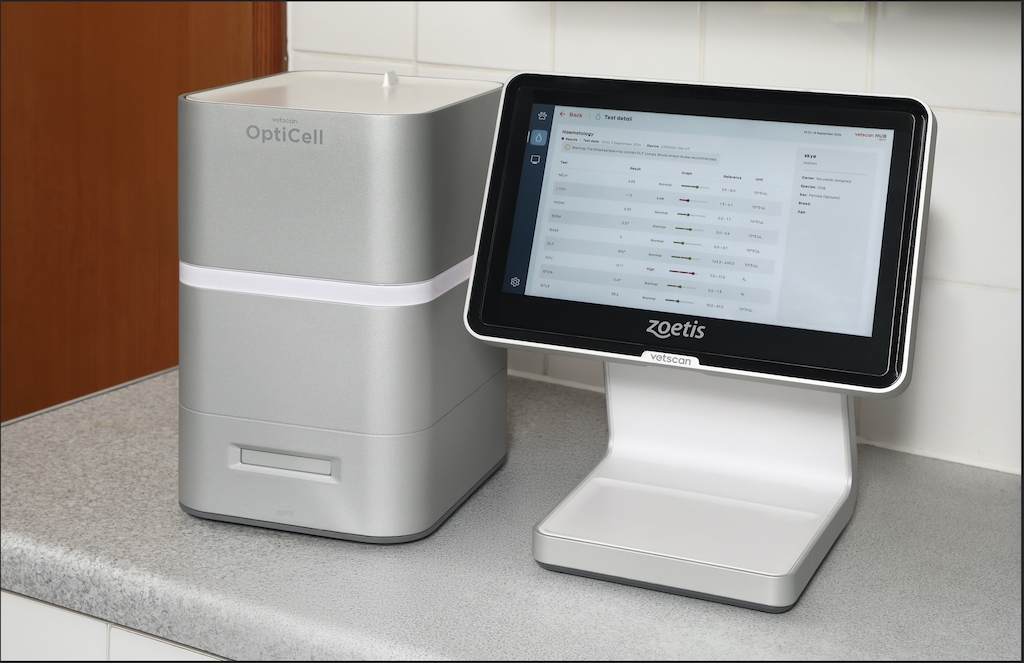
Vetscan OptiCell will become the first point-of-care haematology analyser to offer cellular haemoglobin concentration mean (CHCM) – a parameter previously available only in reference labs
Zoetis Expands Vetscan OptiCell™ Capabilities, Becoming The First And Only Haematology Analyser To Bring Reference Lab Insights In-Clinic
 5 months ago
  1178 views
Zoetis Inc., the world’s leading animal health company, announced today it is expanding the capabilities of Vetscan OptiCell™, its cartridge-based, artificial intelligence-powered haematology analyser, marking the next step in the platform’s evolution. With this update, Vetscan OptiCell will become the first point-of-care haematology analyser to offer cellular haemoglobin concentration mean (CHCM) – a parameter previously available only in reference labs.
The award-winning platform’s first update since its launch in 2025 brings reference lab level complete blood count (CBC) insights directly in-clinic, reaffirming Zoetis’s commitment to innovation that delivers real value to clinicians. The expansion of Vetscan OptiCell’s diagnostic capabilities – which includes CHCM and plateletcrit (PCT) – will increase its total number of parameters to 24, while delivering the same meaningful time, cost, and space savings for veterinary care teams.
Abhay Nayak, President of Global Diagnostics at Zoetis, said: “This latest progression in Vetscan OptiCell’s capabilities further advances the impact that Zoetis diagnostic innovation brings veterinary teams in providing pets and pet owners with the best possible care. Expanded parameters such as CHCM and PCT deliver deeper insights at the point of care and reflect our broader portfolio strategy to deliver a robust pipeline of impactful diagnostics that strengthen clinical decision-making.”
‘Meaningful diagnostic depth’
The addition of CHCM gives clinicians a direct measurement of the average haemoglobin concentration within individually analysed red blood cells. Unlike mean corpuscular haemoglobin concentration (MCHC), which is a calculated value, CHCM is measured optically – providing a more reliable indicator needed when a patient is anaemic and when endogenous interferents, such as haemolysis, are present.
PCT provides the volume percentage of blood occupied by platelets – functionally similar to how haematocrit (HCT) reflects the red blood cell fraction. PCT helps clinicians better assess platelet production, consumption, and evidence of destruction. Both new parameters are expected to be available to Vetscan OptiCell users in 2026.
Dr. Michelle Larsen, Head of Medical Platforms, Clinical Studies, and Medical Education, Global Diagnostic Platforms at Zoetis, said: “CHCM and PCT add meaningful diagnostic depth to the CBC, helping clinicians better understand red blood cell and platelet abnormalities in sick patients. Providing this level of insight in clinic supports clearer interpretation and more responsive case management. I’m excited to see how these additional parameters will help clinicians reach earlier, more confident diagnoses in general practice.”
OptiCell is “the most accurate CBC machine I’ve used”
Speaking about Vetscan OptiCell’s impact at his clinic, Dr Rory Cowlam, Clinical Director at Pickles & Co in London, UK, and member of the Veterinary Diagnostics Innovation Council, said: “OptiCell gives our vets more confidence and increases our offerings to clients on a day-to-day basis. From both a clinic and a patient point of view, the information that we can get at point of care, the speed that we get it, and the accuracy of the data is second to none.”
He added: “The fact that this technology can be enhanced remotely and continue to get even better, with added capabilities, is really exciting. There’s nothing else like this on the market.”
Dr. Sue Ettinger, a veterinary cancer specialist based in New York using the platform, said: “Vetscan OptiCell is the most accurate CBC machine I’ve used. The VEF technology reads through platelet clumps and gives reliable counts, even in cases like lymphocytosis. Being able to trust that first CBC and not having to send it out to a reference lab for confirmation, means I can talk to pet owners right away and make timely decisions in the room, saving time and expense.”
VEF technology
Vetscan OptiCell combines expertly trained artificial intelligence (AI) algorithms with viscoelastic focusing (VEF) technology to count hundreds of thousands of cells during every sample run and analyse them against hundreds of unique parameters for precise cellular classification in minutes.1
Its proprietary microfluidic technology, VEF, allows the analyser to align cells in a single layer for sharp focus imaging, providing accurate platelet recognition, even within clumps – a challenge encountered by traditional haematology analysers.
Compared to reagent pack-based technologies, Vetscan OptiCell’s single-use cartridge-based system - which contains the blood sample, reagents and waste - is easier to use, requires minimal maintenance, eliminates calibration, and prevents cross-contamination.
For a complete haematology picture, CBC results from Vetscan OptiCell can be paired with Vetscan Imagyst® AI Blood Smear, together with expert support via Imagyst Digital Cytology and the Zoetis Virtual Laboratory, within the ZoetisDx portal.
To view the full diagnostics portfolio, visit https://www.zoetisdiagnostics.com/uk
References:
1. Data on file, Study No. DHXMZ-US-24-235, Zoetis Inc.
More from Zoetis
- Vets encouraged to talk to their farming clients about clostridial diseases in beef cattle
- Zoetis Receives Approval for Portela® (relfovetmab injection) in Great Britain
- Zoetis Receives Approval for Lenivia® (izenivetmab) in Great Britain
- Equine Vets Invited to Build Communication Confidence and Clinical Influence
- Zoetis officially partners with Cats Protection
